Breck Farm, Marriotts Park
A major part of the mitigation involved the diversion of wastewater from the neighbouring Taverham Garden Centre, which previously relied on a series of on-site package treatment plants. By connecting the largest of these systems to the mains sewer and directing flows to Whitlingham WwTW, the existing nutrient load associated with the commercial uses was significantly reduced. This diversion created a substantial nutrient surplus, both under current WwTW permit limits and following the tighter standards required under the Levelling Up and Regeneration Act.
Client: M. Scott Properties Ltd
Status: Planning Permission Granted
Services
Flood Risk Services
- Flood Risk Assessment (FRA)
- Sustainable Drainage Strategy
- Flood Defence (Mitigation) Strategy
- Flood Investigation
- Hydrology & Hydraulic Modelling
- Flood Emergency Plan
- Basement Impact Assessment (BIA)
- Groundwater Flooding
- Expert Witness
Environmental Services
- Nutrient Neutrality
- Flow & Water Quality Monitoring & Sampling
- River Geomorphological Survey & Assessment
- Water Framework Directive (WFD) Assessment
- Water Resources Assessment
- Environmental Impact Assessment (EIA)
- Air Quality Assessment (AQA)
- Catchment Management Plans
- Environmental Permits, Licences & Consents
- Expert Witness
Engineering Services
- Sewerage Design
- Sustainable Drainage Systems (SuDS) Design
- Landscape Amenity & Sport Facility Drainage
- Earthworks Design
- River Design
- Roads & Driveways
- Expert Witness
Project details
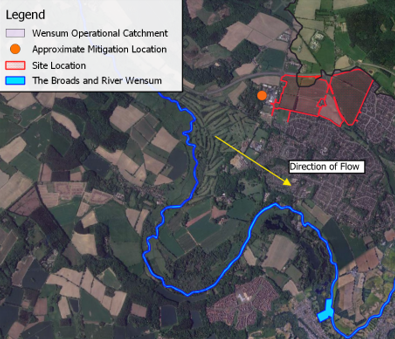
To achieve nutrient neutrality for a linear receptor like the River Wensum, it is required that the mitigation be upstream of the development impact. This was proven in our NNAMS, as seen in the image below.
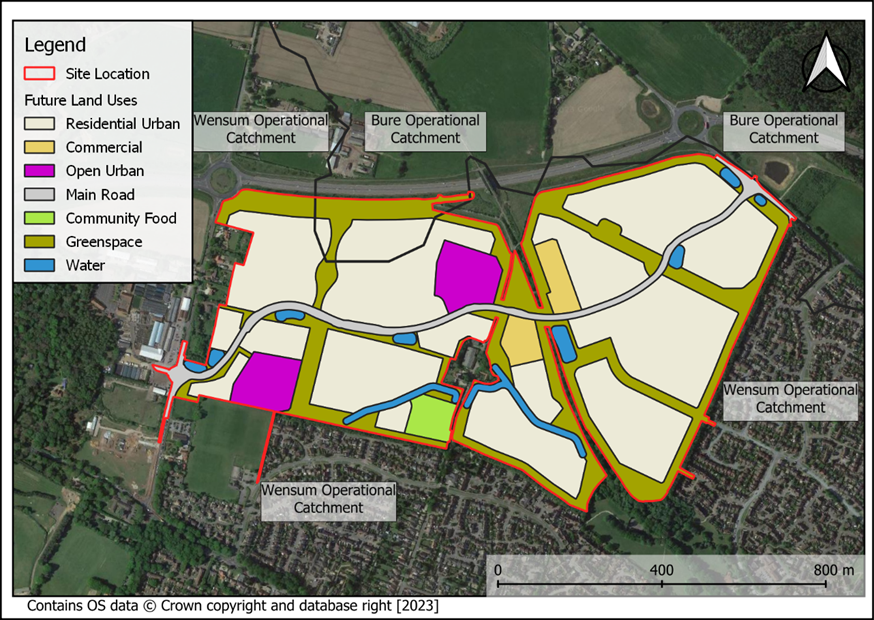
In addition to the off-site wastewater diversion, we advised on a comprehensive SuDS strategy, to reduce nutrient loads from surface water. The site lies across two different catchments (Bure and Wensum), and therefore, the drainage strategy had to be considered separately for both catchments. The strategy incorporated a sequence of retention basins, swales, bioswales and bioretention features, designed to reduce nutrient loads from the surface water, with enhanced measures introduced in the Bure catchment where additional treatment was required. These SuDS elements provided significant reductions in both nitrogen and phosphorus.
Together, the combination of off-site wastewater diversion and on-site SuDS treatment trains formed a robust mitigation solution. This approach delivered the nutrient reductions necessary to achieve nutrient neutrality for the proposed development both before and after the planned upgrades to Whitlingham WwTW.
This work provided a clear and deliverable mitigation strategy and formed a key component of supporting the Habitats Regulations Assessment for this large and strategically important development.