Hoe Valley Flood Defence, Woking
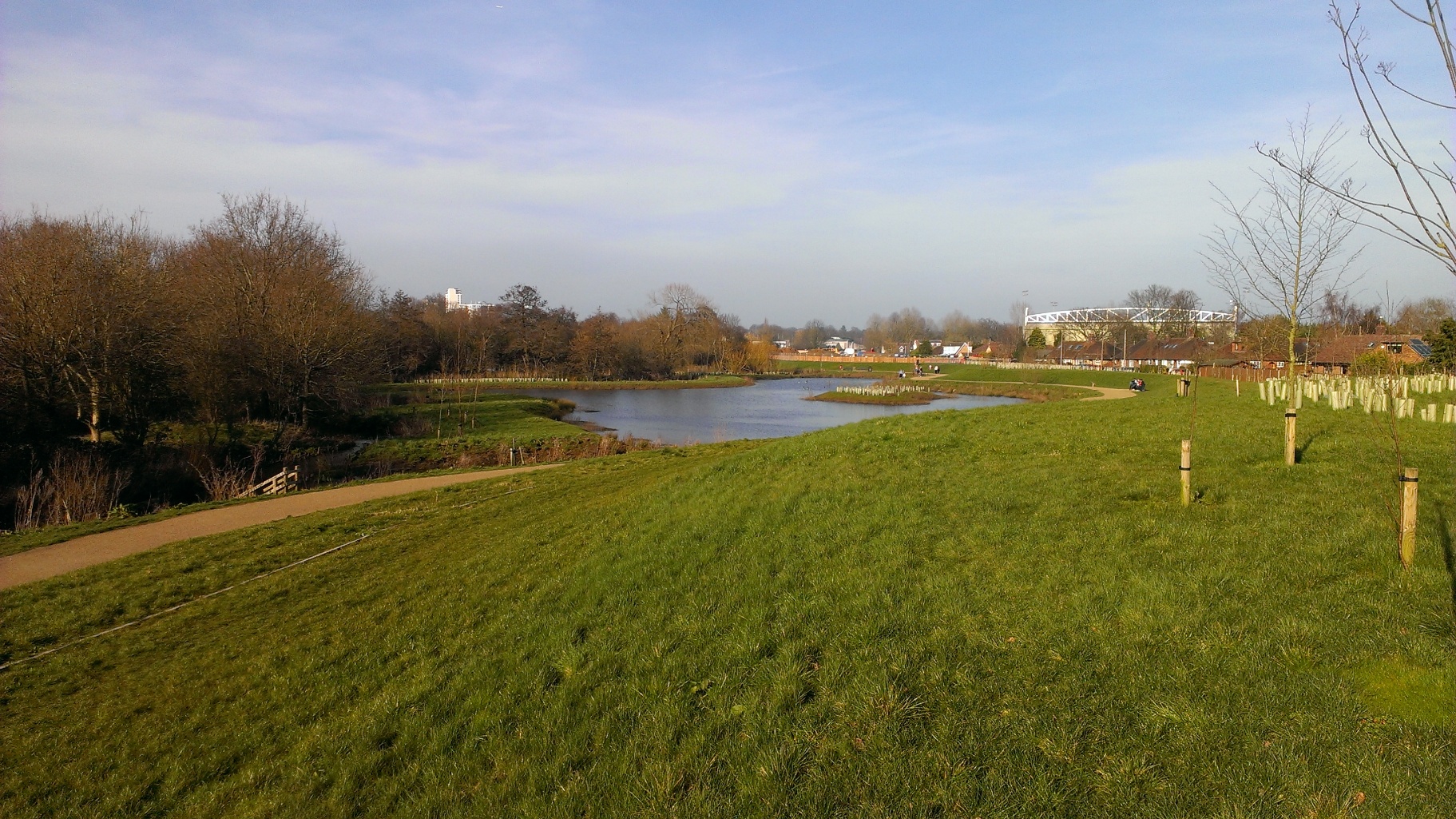
Water Environment Limited worked with Woking Borough Council over a period of four years as the Hoe Valley Flood Defence Scheme evolved from initial concept to a completed linear public park. This was a substantial, multi-disciplinary project with an overall budget of £60 million, of which the flood risk related components amounted to approximately £18 million.
Client: Woking Borough Council
Key Personnel: Tony Clothier
Status: Construction completed
Services
Flood Risk Services
- Flood Risk Assessment (FRA)
- Sustainable Drainage Strategy
- Flood Defence (Mitigation) Strategy
- Flood Investigation
- Hydrology & Hydraulic Modelling
- Flood Emergency Plan
- Basement Impact Assessment (BIA)
- Groundwater Flooding
- Expert Witness
Environmental Services
- Nutrient Neutrality
- Flow & Water Quality Monitoring & Sampling
- River Geomorphological Survey & Assessment
- Water Framework Directive (WFD) Assessment
- Water Resources Assessment
- Environmental Impact Assessment (EIA)
- Air Quality Assessment (AQA)
- Catchment Management Plans
- Environmental Permits, Licences & Consents
- Expert Witness
Engineering Services
- Sewerage Design
- Sustainable Drainage Systems (SuDS) Design
- Landscape Amenity & Sport Facility Drainage
- Earthworks Design
- River Design
- Roads & Driveways
- Expert Witness
Project details
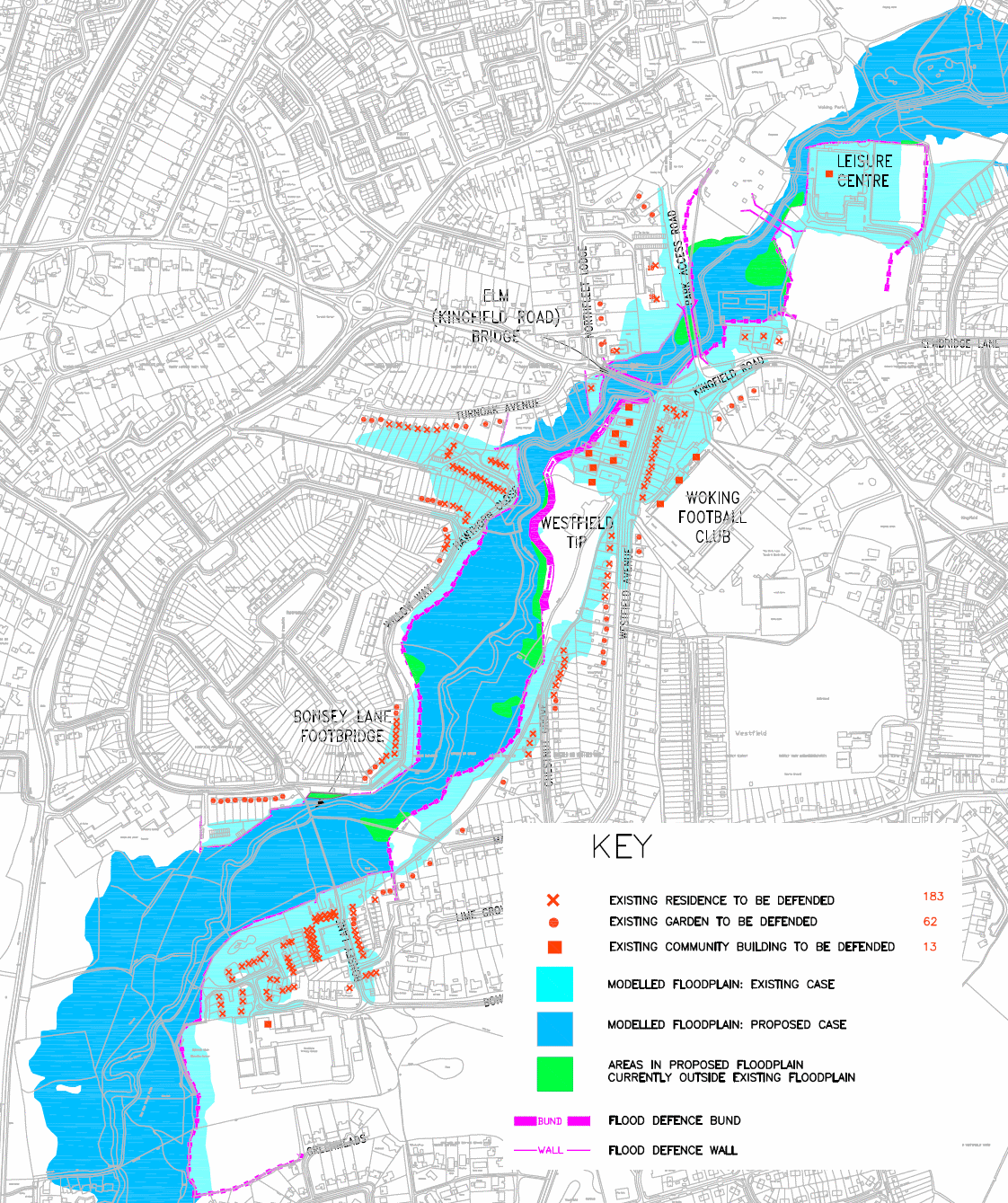
The Hoe Valley scheme was one of the most technically and politically complex flood defence projects Water Environment has undertaken. The River Hoe and its tributaries flow through a densely developed residential area of Woking, and repeated flooding events had affected hundreds of homes and businesses. The challenge was to design a defence scheme that would provide meaningful protection to existing properties while also unlocking significant new development potential on the Westfield Tip brownfield site.
Water Environment undertook extensive hydraulic modelling of the existing river system and assessed a wide range of defence options. A 1D/2D integrated model was developed covering the full length of the scheme, enabling detailed assessment of flood extents and depths under both the existing and proposed conditions. This modelling was fundamental to agreeing the scheme's design parameters with the Environment Agency, who ultimately became co-funders of the project following scrutiny of the hydraulic case.
The defence works comprised a combination of raised earth bunds, flood walls, channel improvements, river diversions, new bridge structures and offline storage areas. A key constraint was the need to maintain conveyance through the valley while providing the required standard of protection — a balance achieved through careful calibration of the hydraulic model against historical flood events.
Water Environment represented Woking Borough Council publicly on several occasions, including at public exhibitions and in discussions with key stakeholders, landowners and concerned local residents. We also played an active role in discussions with various prospective contributors, helping to raise a substantial proportion of the scheme's funding.
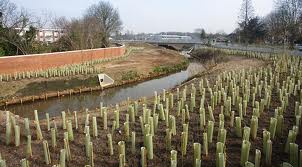
The scheme was designed from the outset as a linear public park, which required a close working relationship with the landscape architects to integrate the functional elements of the flood defence — channel works, bunds, walls and storage areas — into a coherent and attractive public space. The objective was to make the flood defence infrastructure an inconspicuous feature of the landscape design whilst substantially improving the public amenity of the valley corridor.
Sustainability was a guiding principle throughout the design. Wherever possible, treated material from the former Westfield Tip was reused in the construction of the flood defence bunds, minimising the movement of large volumes of material off-site. Recycled aggregate was specified for the construction of the new bridge structures. Sustainable urban drainage systems, including permeable paving, low-flow taps, rainwater harvesting and reed-bed treatment of surface water effluent, were incorporated throughout the park.
This was a large and technically challenging project that required a thorough understanding of civil and structural engineering, landscape design, ecology, and the political pressures inherent in a major Local Authority-led infrastructure programme. The project is a testament to the long-term relationships forged between Water Environment personnel and Woking Borough Council over many years of collaborative working.